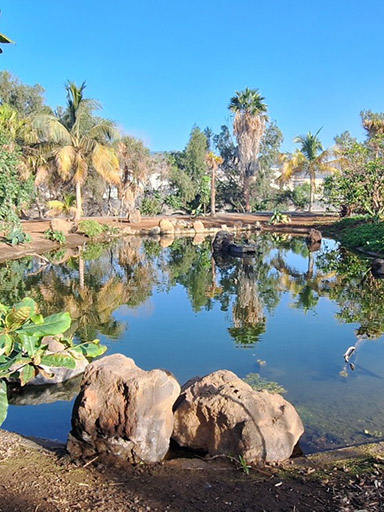

- The capital city council and fundación Moeve have joined forces to improve the botanical garden’s lakes and surroundings, encouraging the establishment of birdlife and its scientific monitoring
The project includes a series of actions aimed at promoting the nesting, resting, and scientific monitoring of different bird species, especially those linked to aquatic environments, as well as to the thermophilic ecosystem.
Among the main improvement measures of the Palmetum's rivers and lakes we have the creation of vegetation islands that facilitate the reproduction of species, such as the common moorhen, that also serve as resting areas for other birds like herons, egrets, and night herons.
Likewise, vegetation on the banks and surrounding areas of the main lakes is being enhanced with the aim of increasing birdlife tranquility and safety. Many native species such as blackbirds, canaries, hoopoes or tabobos, and warblers or capirotes use them as an ideal place to drink and cool off during the hottest moments of the day.
The mayor of Santa Cruz, José Manuel Bermúdez, emphasized that "this collaboration reinforces the City Council’s commitment to urban biodiversity and to the Palmetum as a strategic space for conservation, environmental education, and public enjoyment." Furthermore, he highlighted that "actions like these make Santa Cruz a leader in integrating nature into the city and improving the quality of life of the public."
For her part, the head of fundación Moeve in the Canary Islands, Belén Machado, points out that the Palmetum is a key environmental feature for the city and for its necessary coexistence with nature. It is a living space, at the service of the public, that combines conservation, science, environmental education, and social well-being. This is why we remain committed to this urban botanical garden, where birding is highly important in maintaining the ecosystem’s balance. In particular, the aquatic areas of the Palmetum act as true biodiversity refuges, providing feeding, resting, and breeding spaces for numerous species."
The collaboration between the City Council and fundación Moeve also includes the installation of about twenty shelters and birdhouses made of FSC-certified wood by a local carpenter which are intended for various species – some of great ecological benefit such as swifts (known as andoriñas) and bats, natural allies in mosquito control. They will also be for species in decline in cities, such as the case with Spanish sparrows. This is complemented by the placement of monitoring cameras, which will allow for better knowledge and monitoring of bird populations.
Another noteworthy initiative will be the installation of interpretive panels in the new area of the Palmetum dedicated to the Thermophilic Forest, which will be inaugurated shortly and has also benefited from the collaboration of the fundación Moeve, thereby reinforcing the educational and informative role of the garden.
The project will also be subject to continuous scientific monitoring for two years, which will allow for the evaluation of the progress and success of the interventions, as well as the introduction of possible adjustments or improvements to the measures adopted.