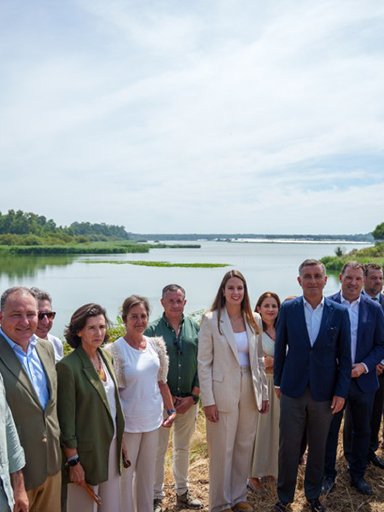

- The Regional Government of Andalusia and fundación Moeve have taken a decisive step toward restoring the Laguna de Las Madres lagoon by signing an action and collaboration protocol to recover one of southern Europe's most valuable wetlands
- This agreement is supported by the municipalities of Moguer and Palos de la Frontera, the area's agricultural sector, the Spanish Government's Huelva Sub-delegation, the Huelva Provincial Council, the Port Authority, the Huelva Business Federation, ASAJA, the Chamber of Commerce, and AIQBE. This alliance, which favors biodiversity, is unprecedented in the territory
- The involvement of the territory's administrations and entities will be essential to carrying out the restoration project, and reinforces a model of public-private cooperation in environmental conservation
Although the collaboration agreement was formalized in December, this meeting marks the realization of our shared vision: restoring this natural area as a collective project involving administrations, the local economy, and society.
The action protocol establishes a framework for collaboration between the Regional Government of Andalusia and fundación Moeve, with the goal of fully restoring the wetland through ecological restoration and sustainable management actions. Furthermore, the protocol promotes a cooperative working model with local stakeholders, integrating administrations, the agricultural sector, and the community to ensure the ecosystem's long-term viability and its contribution to the territory's sustainable development.
In this regard the restoration will focus on recovering natural water dynamics, restoring habitats, and improving biodiversity, including the control of invasive species. It will also promote orderly public use that is compatible with the conservation of the area.
This project will improve the conservation status of the wetland, which is designated as a protected area within the Natura 2000 Network and a Ramsar Site. It will also strengthen the ecological connectivity of a critical gap system in southern Europe.
The planned actions will restore the natural water flow and the ecological processes that allow the functional interconnection between wetlands, facilitating the movement of species, especially waterfowl, and favoring genetic exchange and the resilience of ecosystems. Furthermore, habitat restoration and the removal of pressures will help create an ecological continuum that improves the environmental quality of the entire lagoon system.
This will expand the ecological corridor formed by spaces restored by the foundation in collaboration with administrations, such as Laguna Primera de Palos, Laguna de la Rábida, Marismas del Odiel, and Madrevieja in San Roque (Cádiz), consolidating a network of wetlands that supports biodiversity, scientific research, and environmental education.
Fundación Moeve aims to promote restoration based on the work model applied in Laguna Primera de Palos, a lagoon celebrating its 25th anniversary this year. Recognized as a Ramsar site and Natura 2000 Network (ZEC/ZEPA), this natural area is now a model for environmental recovery. It contains a diverse array of habitats, including over 300 species of flora, 21 of which are threatened, as well as 153 registered bird species. The area has over 18 hectares of restored forest available for public use. This is an example demonstrating that ecological restoration generates cumulative benefits for biodiversity and society when accompanied by continuous maintenance and evaluation of results.
For fundación Moeve, wetland restoration involves reducing risks associated with climate change, improving air and water quality, and creating community spaces for health, education, and environmental culture. The goal is to consolidate a network of natural spaces that strengthen the territory’s resilience.
The involvement of the territory as a key to success
One of the most important aspects of this initiative is the active participation of local stakeholders, especially the Moguer and Palos de la Frontera town councils, responsible for managing the environment and its conservation, as well as the agricultural sector, whose involvement is essential for guaranteeing compatibility between economic activity and sustainability.
This integrative approach turns the project into an example of collaborative governance, where biodiversity conservation is addressed through co-responsibility and dialog.
In the words of Teresa Mañueco, director of fundación Moeve, "wetlands are natural infrastructures of the common good, essential for balancing biodiversity, water, and society." Through this restoration, Huelva will be able to obtain environmental, social, and economic benefits.
The project will increase water resilience in municipalities and agricultural communities by improving aquifer recharge and water retention during periods of drought; reduce climate impact by acting as a carbon sink and temperature regulator; create accessible spaces for environmental education, orderly public use, and citizen participation; recover the territorial identity linked to the landscape; and promote a green economy associated with conservation, research, and sustainable management.
A shared commitment with future impact
The alliance between the Regional Government of Andalusia and fundación Moeve reflects a historical commitment to advancing towards more sustainable development models, where protecting the natural environment is integrated with the needs of the territory.
The Laguna de Las Madres lagoon symbolizes cooperation and a vision for the future. It demonstrates that the combined efforts of administrations, the private sector, and citizens are essential for addressing current environmental challenges.